
Your needs, this model
Does it fit your priorities?
Can the W9493 swing and seat modes both move the child?
No. Mattel documents motorized, five-speed swing mode and a separate stationary infant-seat mode with vibration. The seat-post/latch conversion stops swing movement; vibration is not a second swing axis or a caregiver-driven rocker. The manual calls for a push to start the swing, restraint and adult supervision.
Explore this need in the finder →What battery sets does an identified W9493 require?
Four C/LR14 alkaline cells power swinging and sounds; one separate D/LR20 alkaline cell powers seat-mode vibration. Mattel says batteries are not included. No W9493 wall-outlet plan is documented, so check the exact product label and instructions rather than assuming an adapter can be substituted.
Explore this need in the finder →What ends use before the W9493 reaches its 25 lb maximum?
In swing mode stop when the child becomes active and can climb out; in infant-seat mode stop once the child can sit up unassisted, as Mattel's exact support page states. The manual requires restraint, floor placement and supervision, and the current support warning excludes sleep and unsupervised use. Mattel does not give a numerical minimum weight or explicit from-birth claim on the reviewed page.
Explore this need in the finder →Mattel identifies the W9493 as the Discover 'N Grow Swing & Seat, a 2012 model built around two different arrangements: a powered swing and a stationary infant seat with vibration. The distinction is useful, but it also makes the operating limits easy to blur. Swing motion uses four C batteries; vibration needs a separate D cell. Mattel lists five swing speeds and a 25 lb maximum, but the developmental stop differs by mode. This is an evidence-based guide to the exact support record and linked W9493 instructions, not a report of hands-on use.
Two arrangements, not two kinds of swing
The exact W9493 product page describes a seat that converts from swing mode to a stationary positioner. In swing mode, an adult selects one of five speeds and gives the seat a light push to start; the manual's setup notes explain that a child must be seated for the swing to operate. Seat mode parks the swing post and uses the separate vibration switch. It does not provide a second powered travel direction, a manual-rebound rocker, or a second swing arrangement that can be matched as multi-axis movement.
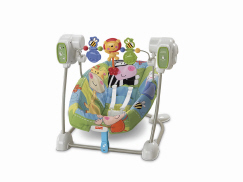
Mattel describes handles as a portability convenience and calls the design compact, but neither statement supplies assembled width, depth, height, or moving-clearance dimensions. The product photo is a small model-style reference, not a measuring image. Check the actual room and any carried path yourself, and do not infer a carry-with-child approval from the handles. The manual explicitly says the toy bar is not a handle.
The battery split is easy to overlook
W9493 requires four C/LR14 alkaline cells for swing and sound operation and one separate D/LR20 alkaline cell for seat vibration; the manual says the batteries are not included. There is no documented W9493 wall-adapter arrangement in the exact support materials reviewed. Do not count the D cell as swing power, combine the two battery jobs into a more capable mode, or assume a plug-in adapter is interchangeable. The controls are on the product itself: main power, swing speed/power, music/volume and vibration switches. Mattel says music and sound effects can be used in both modes, so using seat-mode vibration and sound requires the relevant separate power supplies.
The five speed settings are choices, not a promise of a particular pace or soothing response. The manual says to push the seat to start and offers setup suggestions if the motion stops at a lower setting; it also notes that a heavier child reduces the motion. Those directions are not an independent performance test, and they do not establish measured speed, noise, battery life or how any individual baby will respond.
Use the stop condition for the mode in use
The manual sets a 25 lb maximum and says to stop swinging sooner if the child becomes active and may climb out. Mattel's exact support age statement gives a separate seat-mode limit: discontinue the infant-seat mode once the child can sit up unassisted. The weight ceiling does not override either condition. The reviewed W9493 page and manual do not state a numerical minimum weight or expressly label the model for use from birth, so neither newborn readiness nor a minimum-size fit should be inferred from the words “infant seat.”
Keep the restraint fastened, use the product only on the floor, and remain nearby watching the child. The manual says it is not a substitute for a crib or bassinet for prolonged sleep, while Mattel's current support warning says swings and bouncers are not safe for sleep or unsupervised use. If a child falls asleep, move them to a firm, flat sleep surface as the current warning directs. These are not optional accessories or quiz preferences.
Wash the pad separately; wipe the rest
The W9493pr-0821 manual says to remove the pad and wash it separately in cold water on a gentle cycle, without bleach, then tumble dry it separately on low and remove it promptly. It directs caregivers to wipe the frame and toy bar with a mild cleaning solution and a damp cloth, rinse away residue, and avoid harsh or abrasive cleaners. That is a narrow textile-care claim: it does not mean the complete seat, frame, toy bar or battery housings can go into a washing machine. Follow the pad reassembly steps and check that the restraint passes back through the correct slots before the next use.
What a W9493 listing still needs to show
Mattel's exact U.S. support pages identify W9493 and report its 2012 release, but the discontinued field is blank; these records do not prove that a current seller has an offer. The support page also says replacement parts are not currently available. A used listing should therefore show the W9493 label, the fitted restraint, intact seat-post and latch, frame joints, battery compartments, pad and toy bar. The W9493 manual warns against use with missing or broken parts and against substituting parts. Check current recall notices for the exact model and any unit-specific identification; the bounded index review here is not clearance of a particular used swing.
The image on this page is Mattel's W9493 support image and illustrates model appearance only. It does not verify a seller's package, condition, completeness or dimensions. The useful case for this older seat is its documented five-speed swing plus a separate stationary vibrating-seat option; its practical costs are two different battery types, mode-specific stop rules, no verified outlet plan and unknown space requirements.
Primary sources: Mattel's W9493 U.S. support page, its technical product record, the linked W9493pr-0821 manual and W9493 Quick Start Guide, checked 2026-11-03.
Key specifications
Key details at a glance
| Motion type | Powered swing; movement axes not specified |
|---|---|
| Powered speed settings | 5 |
| Power modes | Four C (LR14) 1.5 V alkaline cells, not included, power swing and sounds. / One separate D (LR20) 1.5 V alkaline cell, not included, powers vibration in stationary seat mode. / No W9493 wall-outlet or AC-adapter operating arrangement is established by the reviewed exact sources. |
| Manufacturer-listed weight limit | 25 lb |
| Machine-washable seat textiles | Yes |
Use the exact model’s instructions for operating limits, supplied equipment and version differences.
Sources for this review
Sources for this assessment
- Discover 'N Grow Swing & Seat W9493 — Mattel U.S. support page
- W9493 Discover 'N Grow Swing & Seat — Mattel technical product support
- W9493 Discover 'N Grow Swing & Seat manual, W9493pr-0821
- W9493 Discover 'N Grow English/Spanish instructions, W9493-2L (byte-identical to W9493pr-0821)
- W9493 Quick Start Guide, W9493qs-4L
- W9493 Quick Start sheet, W9493pr-0825 (byte-identical to W9493qs-4L)
- Mattel U.S. Recall & Safety Alerts index — bounded W9493 screen
- Official Mattel W9493 support image

Compare this model with your actual requirements
Use the finder to combine movement, power, control, care, newborn support and published body dimensions. It does not calculate motion clearance or override model-specific warnings.