
Your needs, this model
Does it fit your priorities?
Why can a from-birth label still leave a narrow fit window on J6978?
Mattel's exact product description lists use from birth, but the J6978 manual sets a 20 lb maximum and says not to use it once a child can sit up independently (about six months); it also requires stopping earlier if the child becomes active and appears able to climb out. The sources state no minimum weight, and the from-birth phrase is not proof of an individual infant's fit.
Explore this need in the finder →Does J6978 swing in two directions at the same time?
No. Its J6978 manual tells an adult to unlock and rotate the seat tube to choose front-to-back swing or side-to-side cradle motion. Treat those as alternative selectable directions, not simultaneous travel or a measured room-clearance envelope.
Explore this need in the finder →What can be machine washed on this older swing?
The exact J6978 sheet permits machine washing the removed pad and toys in cold water with mild detergent and no bleach, then tumble-drying on low and removing them promptly. It directs caregivers to wipe the seat, restraint, tray, mobile, fabric panel and motorized frame separately. That is not a whole-swing machine-wash instruction.
Explore this need in the finder →This assessment is for the U.S. Fisher-Price Nature’s Touch Baby Papasan Cradle Swing identified by model J6978. Mattel’s support record reports a 2006 release and a 2008 discontinuation; it does not establish a present-day retail offer, price, seller or exact package. The product page links a J6978-numbered instruction sheet, which is the basis for the operating limits here. This is a source review, not a hands-on test or inspection of a particular used swing.
Two selectable travel directions, not simultaneous motion
Mattel describes this cradle swing as able to move front-to-back or side-to-side. The J6978 sheet shows an adult unlocking and rotating the seat tube to choose the desired direction. That is a real difference from a one-direction-only seat, but it should not be read as both axes moving together or as a measurement of the seat’s swept path. The manual and support text do not give a floor-clearance envelope; leave space for motion and for an adult to reach the child.
The support description lists six swing speeds, eight songs and nature sounds, along with a motorized overhead mobile with three characters. It also names an infant head-support insert and two recline positions. The instruction sheet has on-unit power, speed, sound, volume and mobile controls; the exact sources reviewed do not document phone-app, remote or voice-assistant adjustment. A feature list tells a shopper what the model was described as having, not whether a second-hand package still contains every part or whether an old unit’s controls work.
Four D cells are the documented power plan
The product page lists four “D” cells, and the exact J6978 manual specifies four D (LR20) alkaline batteries that are not included. The support and instruction records reviewed do not describe a mains-adapter operating plan. Do not assume an adapter from another Fisher-Price swing fits; if buying a used unit, match the label to J6978 and follow the J6978 sheet rather than experimenting with an unverified power supply.
Battery operation avoids placing a mains cord near the moving frame, but it requires four appropriate cells and an intact battery compartment. Inspect it for leakage, corrosion, damaged contacts or a missing cover before considering a used example. The original manual also says to remove batteries for long-term storage. It provides no battery-runtime figure, so the number of days or hours between replacements cannot be estimated from the source record.
A 20 lb maximum is not the only stop rule
Mattel’s support page says use from birth until the child becomes active and can climb out. The J6978 manual adds a 20 lb maximum and says the product is not recommended for a child who can sit up independently, giving about six months as an approximate age reference. It also says to stop immediately if a child below the weight limit is active and appears able to climb out. These conditions are not interchangeable: reaching 20 lb is a hard upper limit, while independent sitting or activity may end use earlier. The sources do not state a numerical minimum child weight, and “from birth” does not confirm that this particular seat or harness fits an individual infant.
The exact instructions require the restraint system every time and warn that the tray is not a restraint. They say not to leave a child unattended and warn against placing the swing on an elevated surface. Mattel’s current support page carries its updated warning that swings are not safe for sleep or unsupervised use. These are use restrictions, not proof that a particular older frame, buckle or used fabric is in sound condition.
Wash the pad and toys, not the assembled swing
The J6978 sheet permits machine washing the removed pad and toys in cold water with mild detergent and no bleach; it then calls for low-heat tumble drying and prompt removal. The seat, restraint, tray, mobile, fabric panel and motorized frame have separate wipe-clean directions, followed by rinsing away cleaner residue. That distinction matters in a household comparing machine-washable textiles: it does not mean the assembled product, motor or complete seat can go into a washer. Recheck the care label on the particular pad before using any cleaning method.
Storage and used-unit checks
Mattel says the swing folds for storage, and the manual depicts the legs folding inward. Neither source gives assembled width, depth or height, folded dimensions, total product weight or a travel/carry specification. Folding can make a product easier to put away, but it cannot tell you whether the active frame fits a chosen corner. Measure the actual assembled unit and allow more room than its static body outline for selected seat motion and caregiver access.
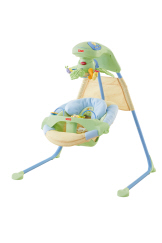
The original J6978 support image is small and is useful only for identifying the illustrated model style. It does not prove the finish, parts, condition, restraint integrity or dimensions of a seller’s unit. Before relying on an older listing, read the model number on the frame and compare the included parts with the correct J6978 instructions. Confirm the pad, restraint, battery door and any listed infant head support are present and intact; the support page cautions that features and decorations may vary from photographs.
What this record cannot settle
The exact sources establish a battery-powered, two-direction-selectable earlier swing with a 20 lb manual maximum and component-level wash instructions. They do not establish a current offer, minimum weight, room dimensions, power-adapter compatibility or the contents and condition of an individual second-hand package. A bounded Mattel recall-index screen did not display J6978, but that observation is not a complete recall history or clearance of a specific unit; check current official safety information against the exact label and any available product identifiers. If a listing cannot be tied to J6978 and its matching instructions, this assessment should not be used to fill in missing details.
Key specifications
Key details at a glance
| Motion type | Powered movement in multiple directions |
|---|---|
| Powered speed settings | 6 |
| Power modes | battery |
| Manufacturer-listed weight limit | 20 lb |
| Approximate age reference | 6 months |
| Machine-washable seat textiles | Yes |
| Newborn insert included | Yes |
Use the exact model’s instructions for operating limits, supplied equipment and version differences.
Sources for this review
Sources for this assessment
- Nature’s Touch Baby Papasan Cradle Swing J6978 — Mattel U.S. product support
- J6978 technical product support — Mattel
- Nature’s Touch Baby Papasan Cradle Swing J6978 instruction sheet, J6978d-0728
- Mattel U.S. Recall & Safety Alerts index — bounded J6978 screen
- Mattel official J6978 Nature’s Touch support image

Compare this model with your actual requirements
Use the finder to combine movement, power, control, care, newborn support and published body dimensions. It does not calculate motion clearance or override model-specific warnings.