
Your needs, this model
Does it fit your priorities?
Does N1973 move in two directions at once, and what powers it?
No simultaneous directions are documented. The exact N1973 manual directs the caregiver to rotate the seat tube to choose side-to-side cradle motion or front-to-back swing motion. Its only documented swing power is four D (LR20) alkaline batteries, not included; no AC-adapter plan appears in the exact sources reviewed.
Explore this need in the finder →What is N1973’s capacity boundary for an infant?
Mattel lists use from birth until a child becomes active and can climb out. The exact manual caps N1973 at 25 lb (11.3 kg) and says to stop sooner if the child is active and appears able to climb out. No numeric minimum weight or individual newborn fit assessment is documented; use the restraint and supervise awake use.
Explore this need in the finder →Can N1973’s fabric be machine washed?
The N1973 manual allows a cold machine wash of the removed pad with mild detergent and no bleach, followed by low-heat tumble drying and prompt removal. The seat, restraint, tray, mobile, fabric panel, and frame have separate damp-cloth cleaning directions; do not wash the complete swing.
Explore this need in the finder →Model scope: This review is for the earlier U.S. Fisher-Price Nature’s Touch Baby Papasan Cradle Swing bearing Mattel product number N1973. It is not a current retail offer or a condition report for a particular secondhand unit.
What the N1973 record establishes
Mattel’s U.S. support page identifies the Nature’s Touch Baby Papasan Cradle Swing as product N1973, reports a 2008 release and 2009 discontinuation, lists four D batteries, and describes use from birth until a child becomes active and can climb out of the seat. The exact support page links a model-numbered N1973 instruction sheet. That is enough to distinguish this observed swing from the similarly named J6978 and M5584 records, but not to identify a retail SKU, finish suffix, seller, live offer, or the parts supplied with any used example.
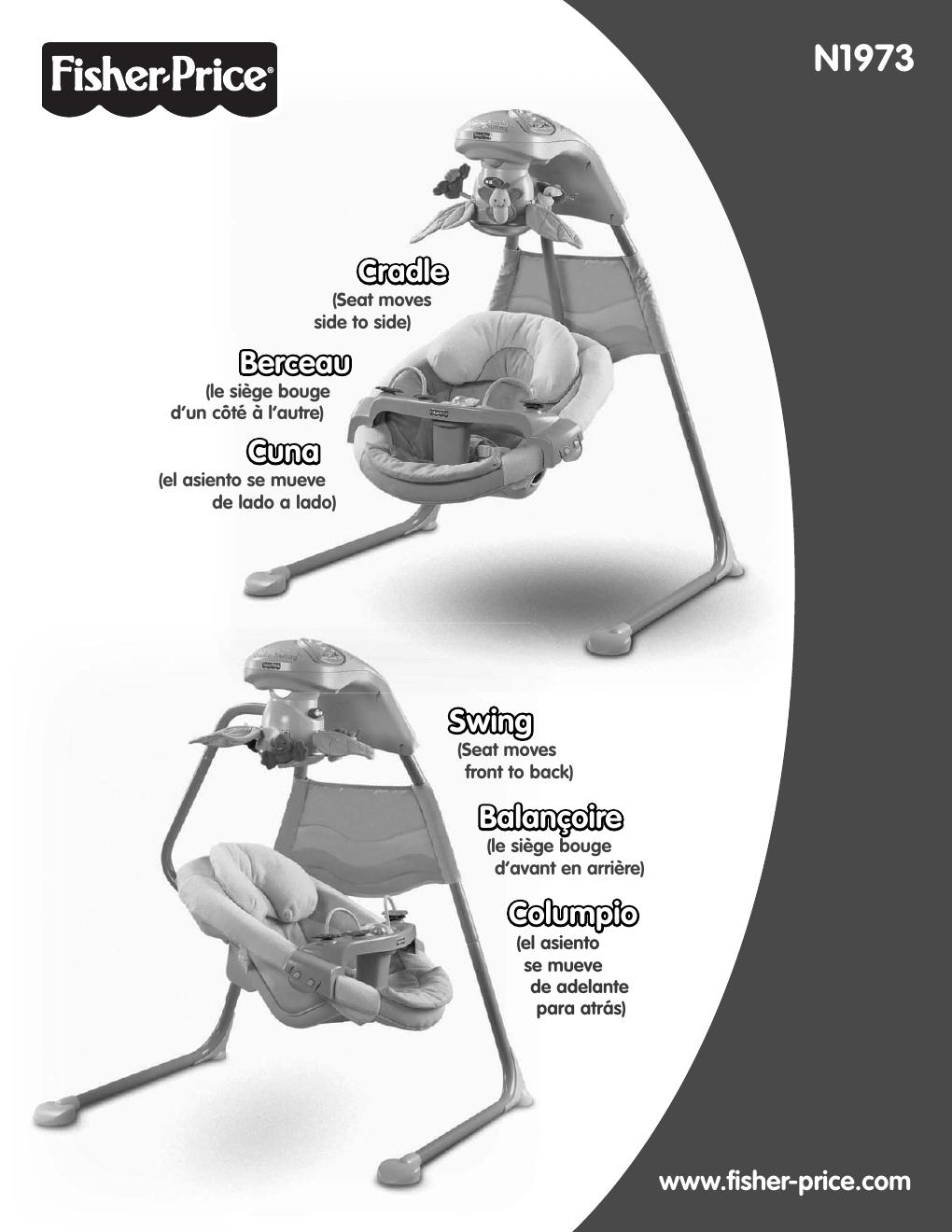
For an old listing, verify the product number on the swing itself and obtain the N1973 manual. Similar names are not interchangeable model identities. The official support page’s embedded thumbnail uses a G2609 image filename; I have not used that image as an N1973 photograph. The picture on this page is instead the N1973 manual-cover illustration, which visibly names the model and depicts both documented seat orientations.
Two selectable swing directions, not two simultaneous axes
The N1973 sheet describes a powered seat that can be oriented as a side-to-side “Cradle” or a front-to-back “Swing.” Its instructions tell the caregiver to press the seat-tube button and rotate the tube to the desired position. Read that as a choice of travel direction before use—not simultaneous multi-direction movement, a separate manual-bouncer setting, or a measured motion-clearance envelope. The manual also shows two seat positions, reclined and upright, and six swing-speed settings.
Those distinctions matter in a room: the seat’s static body dimensions and its moving path are different questions. The examined N1973 sources do not publish an assembled width, depth, height, folded dimensions, or clearance zone. Measure the actual setup and leave room for the chosen direction and caregiver access; during assembly the manual directs the user to check that all feet sit flat on the floor. This assessment cannot determine whether it fits beside a wall or furniture.
Power and controls
The exact instruction sheet requires four D (LR20) alkaline batteries, which are not included in the original package. Its power dial has six swing-speed positions. The manual depicts on-product switches for the mobile and music/sounds, a volume dial, and a reset button. Mobile, music, or sounds switch off after about seven minutes; pressing reset starts another interval. That is an accessory shutoff, not an automatic swing timer.
No AC-adapter arrangement appears in the N1973 support record or the linked instructions reviewed here. They also do not document phone-app, voice-assistant, or remote control. Treat those capabilities as unknown, not as a reason to substitute a similar model’s power supply. If a used listing shows an adapter, identify it against the N1973 instructions rather than assuming that a connector that fits is electrically compatible.
Weight and developmental stopping points
The N1973 manual sets a 25 lb (11.3 kg) maximum and says to stop sooner if a child under that limit is active and appears able to climb out. Mattel’s support wording likewise ends use when the child becomes active and can climb out. The sources examined do not specify a numerical minimum weight, an independent-sitting cutoff, or an age at which use should continue. A “from birth” listing is not an individual newborn-fit assessment and does not override restraint fit, the manual, or the earlier stop.
Use the restraint every time; the tray is not a restraint. The manual says not to use the swing without its pad and not to leave the child unattended. Mattel’s support page also carries the later warning that swings, rockers, and bouncers are not for sleep. This is an awake-use seat, not a sleep space, and a capacity number is not a promise of duration or developmental readiness.
Cleaning, assembly, and the used-unit check
The N1973 instructions call for machine-washing the removed pad in cold water with mild detergent and no bleach, then tumble-drying on low and removing it promptly. The seat, restraint, tray, mobile, fabric panel, and motorized frame have separate damp-cloth cleaning directions. Machine-washing the pad does not mean the complete seat or frame can go in a washer.
The manual’s parts illustrations identify a pad with headrest, restraint system, tray, storage pouch, motorized frame, legs, and mobile. Those are a manual parts reference, not a guarantee that a used unit has all parts or that the headrest, straps, tray locks, battery door, fasteners, or frame are intact. Check for missing, damaged, altered, or loose components before considering an old swing; do not improvise replacement restraints, support parts, or adapters. The manual describes folding the legs for storage, but no folded measurement or travel-carry claim is provided.
Who should keep it on a shortlist?
N1973 is relevant only when a household has located this exact earlier model and can verify its label, original manual, parts, condition, safe setup, and current safety notices. It has documented two-direction powered motion, local controls, four-D-cell operation, a removable washable pad, and a 25 lb maximum. It has no documented outlet plan or published body dimensions in the sources reviewed. Mattel says it was discontinued in 2009, so this record should not be read as evidence that a new unit is available. The central purchase page is an assessment scenario and a fixed exact-model search route, not proof of an active listing.
Primary sources and limits
Mattel’s N1973 U.S. support record identifies the product and its lifecycle, battery information, age wording, and linked instructions. The N1973pr-0720 instruction sheet supplies the movement, six speeds, 25 lb limit, restraint, cleaning, assembly, and storage details. Its cover is the illustration shown here; neither source establishes an offer-specific package or a particular unit’s condition. A limited screen of the Mattel recall index is not a complete recall history or clearance of a used item or serial number. Check current official safety notices against the exact model and unit.
Key specifications
Key details at a glance
| Motion type | Powered movement in multiple directions |
|---|---|
| Powered speed settings | 6 |
| Power modes | Powered by four D (LR20) alkaline batteries, not included. The reviewed exact N1973 sources do not establish an AC-adapter arrangement. |
| Manufacturer-listed weight limit | 25 lb |
| Machine-washable seat textiles | Yes |
Use the exact model’s instructions for operating limits, supplied equipment and version differences.
Sources for this review
Sources for this assessment
- Fisher-Price Nature’s Touch Baby Papasan Cradle Swing N1973 — Mattel U.S. support
- Mattel U.S. support-search page 2 — frozen N1973 catalog observation
- N1973 Nature’s Touch Baby Papasan Cradle Swing instruction sheet N1973pr-0720
- Official N1973 instruction-sheet cover illustration
- Mattel U.S. Recall & Safety Alerts index — limited N1973 screen
Compare this model with your actual requirements
Use the finder to combine movement, power, control, care, newborn support and published body dimensions. It does not calculate motion clearance or override model-specific warnings.