
Your needs, this model
Does it fit your priorities?
What does Mattel document for CDJ49 from-birth use and the stop limit?
Mattel's exact CDJ49 page says use from birth until the child attempts to climb out, while the linked instructions set a 25 lb maximum and require the seat to stay fully reclined until both at least four months and independent head control. No minimum child weight is stated. The from-birth wording does not establish fit for a particular infant or extend use past an earlier activity/climb-out stop; use the restraint, stay close and never use the swing for sleep.
Explore this need in the finder →How can CDJ49 swing and which power options are documented?
The linked manual says an adult can unlock and rotate the seat tube to choose side-to-side cradle or front-to-back swing motion; it does not swing in both directions at once. Mattel lists six speeds, on-unit controls, an original 6 V DC AC adapter, or four D/LR20 alkaline batteries not included. Verify the exact used unit's manual and adapter; no compatible substitute or current offer is established.
Explore this need in the finder →What is washable on CDJ49 and what should be checked on an older unit?
Mattel calls the seat textiles, head support and pad machine washable; the linked manual gives detailed machine-wash directions for the removed pad only: cold water, mild detergent, no bleach and low-heat tumble drying. Wipe the other seat, restraint, canopy, mobile and frame surfaces as directed, and verify the unit's care label. Check its CDJ49 label, five-point restraint, head support, undamaged joints, correct adapter and current safety notices; the exact image and bounded recall-index screen do not clear an individual used unit.
Explore this need in the finder →Scope: This is a source-based assessment of the U.S. Fisher-Price Starlight Cradle ‘n Swing identified by Mattel as CDJ49, not a hands-on test or a review of a particular secondhand unit. Mattel reports a 2014 release but leaves its “Discontinued” field blank; no current offer, retail SKU or present package is established.
Two selected directions, not two motions at once
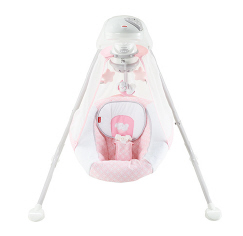
CDJ49 is a powered cradle swing with a choice between side-to-side cradle movement and front-to-back, head-to-toe swinging. Its manual shows an adult unlocking and rotating the seat tube to select an orientation. That is a real multi-direction option, but not simultaneous motion, and Mattel publishes no swept path or clearance measurement. The six swing speeds are selected on the unit. The product page describes SmartSwing technology that senses the child’s weight and starts without a push; it publishes no performance curve or measured speed results.
Do not confuse movement with seat adjustment. Mattel lists three facing positions—right, center and left—while the manual specifies two seat-back positions, recline and upright. Neither adds another swing direction. The original configuration includes a five-point restraint and removable padded head support, but a used unit still needs its own intact harness, head support and matching instructions.
The support page also lists 16 songs, nature sounds, a motorized mobile with three soft toys and a starlight projection on the canopy. The manual says swing motion turns off after about four hours; mobile, music and sounds stop after about 20 minutes unless restarted. Those timers are shutoffs, not evidence that the product is a sleep space.
Outlet or D-cell operation
Mattel documents AC-adapter or four-D-cell swing operation. The original configuration includes an adapter; the manual specifies 120–240 V AC input at 50–60 Hz and 6 V DC output. Four D (LR20) alkaline batteries are the alternative and are not included. These are two power plans for the same swing, not separate products, and they establish no battery runtime or replacement-adapter compatibility. Before relying on a used example, confirm the correct, undamaged adapter is present. The manual calls for a standard wall outlet, prohibits extension cords and says to disconnect the adapter before cleaning.
From-birth wording has a strict position condition
Mattel’s support page says use from birth until the child attempts to climb out. The manual adds a critical posture rule: keep the seat fully reclined until the baby is at least four months old and can hold their head up without help. Both conditions must be met before moving upright. The maximum is 25 lb, but the manual says to stop sooner if an active child appears able to climb out. It gives no minimum child weight. The head cushion and “from birth” line cannot establish fit for an individual infant; follow the exact unit’s directions and labels.
Use the restraint, keep the swing on the floor and stay with the child. Mattel says it is not intended to replace a crib or bassinet for prolonged sleep; CPSC’s broader safe-sleep guidance also says infant swings are not sleep surfaces. If a baby falls asleep, move them to an appropriate firm, flat sleep space.
Textile care and the space question
Mattel identifies the head support and seat textiles as washable. The manual’s detailed directions are for the removed pad: cold water, mild detergent, no bleach and low-heat tumble drying, removed promptly. It gives separate damp-cloth instructions for the seat, restraint, canopy, mobile and motorized frame. Do not put the whole assembly in a washer; check the sewn care label and exact unit instructions for older fabrics.
The support record says the legs fold for storage or room-to-room movement, but gives no assembled width, depth, height, folded dimensions or product weight. Two selectable directions also do not reveal their clearance envelope. Measure the actual frame and allow room for its motion. The manual requires adult assembly and says not to use the swing if parts are missing or broken.
Who should consider this assessment—and who should keep looking
CDJ49 is an earlier-model comparison for someone who wants selectable swing direction, six local speeds, washable seat textiles and either outlet or battery power. It is a poor fit for a must-have current model, app or voice control, known dimensions, a weight threshold above 25 lb, or an outlet routine that depends on a particular used adapter being included. Mattel’s page currently says replacement parts are not available, so check completeness rather than assuming a missing piece can be ordered.
Other Fisher-Price swings may share selectable motion or power options, but their manuals and accessories are not interchangeable. The separate K7923 assessment documents its own instructions and adapter/battery choices; it does not prove that a K7923 adapter, harness or component fits CDJ49.
A bounded search of Mattel’s saved Recall & Safety Alerts index did not show CDJ49. That is not a complete historical search or clearance of a particular unit, date code or serial number. Check current Mattel and CPSC notices against the exact label, and inspect the frame, joints, restraint, pad, head support and wiring. The official image identifies model appearance only; it does not show a sale package or individual unit.
Bottom line: CDJ49 documents two manually selected swing directions, AC or four-D-cell power, six speeds, two reclines, washable seat textiles and a 25 lb ceiling. Unknown dimensions, present availability and unit-specific condition limit what can be inferred. Its infant-position, restraint, sleep and stop-use rules matter more than the feature count.
Key specifications
Key details at a glance
| Motion type | Powered movement in multiple directions |
|---|---|
| Named motion patterns | 2 |
| Powered speed settings | 6 |
| Built-in sound choices | 16 |
| Power modes | Original configuration: 6 V DC AC adapter for wall-outlet operation; exact adapter included with original product, but presence/condition on a used unit is unknown. / Alternative: four D (LR20) alkaline batteries for swing operation; batteries not included. |
| Manufacturer-listed weight limit | 25 lb |
| Harness points | 5 |
| Machine-washable seat textiles | Yes |
| Newborn insert included | Yes |
Use the exact model’s instructions for operating limits, supplied equipment and version differences.
Sources for this review
Sources for this assessment

Compare this model with your actual requirements
Use the finder to combine movement, power, control, care, newborn support and published body dimensions. It does not calculate motion clearance or override model-specific warnings.