
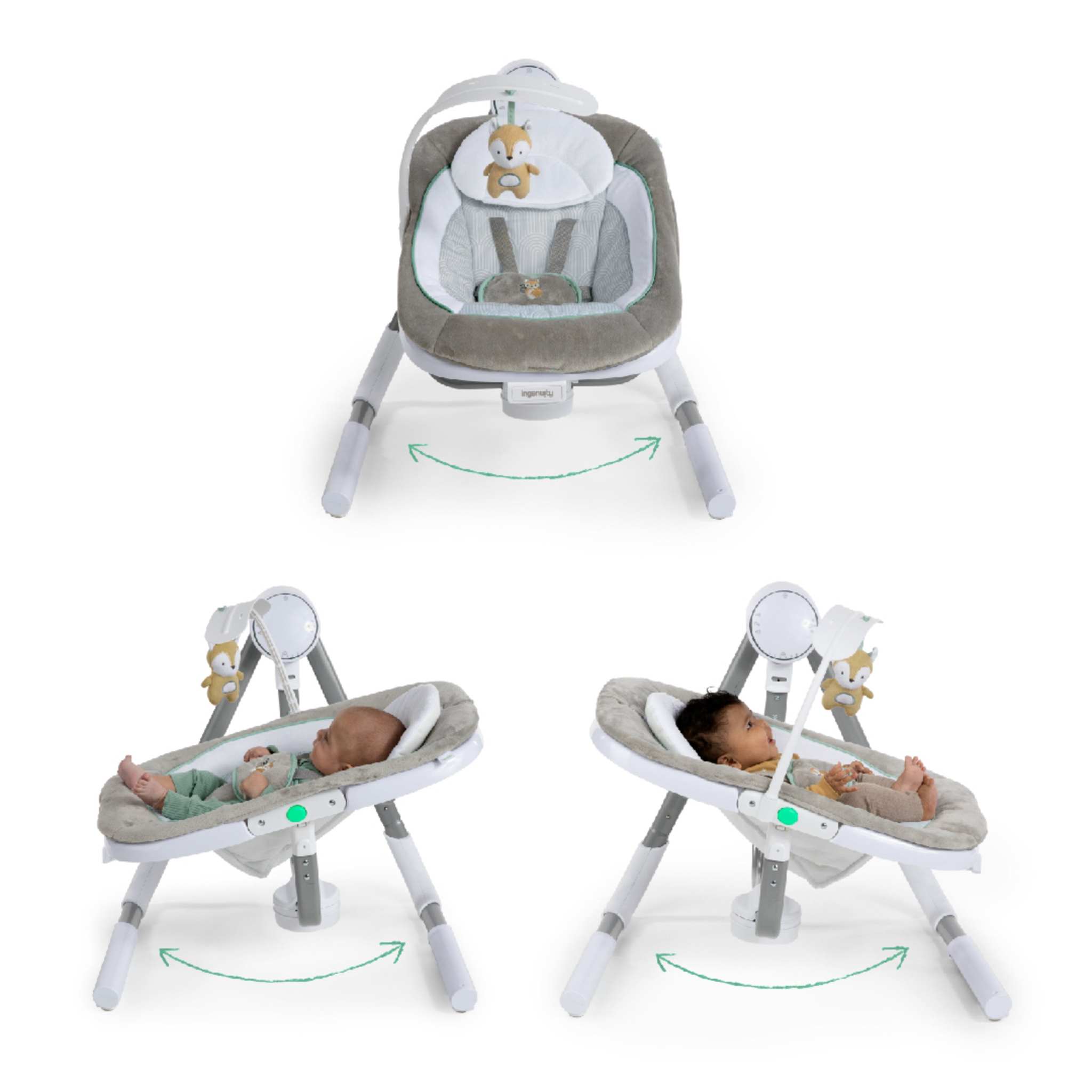
Your needs, this model
Does it fit your priorities?
Does the Ray swing provide powered movement in more than one direction?
The exact Ray page describes 180-degree seat rotation and swinging in three directions. The manual remains the authority for installation, posture and stop conditions; the motion label is the maker's description, not an independently measured result.
Explore this need in the finder →Can the swing run on a C battery when there is no outlet?
No battery-powered swing motor is documented. The included USB cable powers the swing and sounds through a compatible 5 V/1 A USB-A adapter, which is not included. One C/LR14 battery powers vibration only.
Explore this need in the finder →What use limits and seat-care details matter for the Ray?
The exact manual sets the swing range at 6–20 lb, stops swing use after unaided sitting or above 20 lb, and says to stop the stationary seat when the baby starts trying to sit up. Keep the swing fully reclined until at least four months and head control, supervise continuously, and move a sleeping infant to a firm, flat sleep surface. It gives different wash and dry instructions for the seat pad and headrest.
Explore this need in the finder →How much room should be reserved around the Ray?
Ingenuity lists a 28.35 in body width and 36.61 in front-to-back dimension. Those figures do not include the moving seat's clearance, accessible routes or cord path; measure the assembled swing area and follow the floor-placement instruction.
Explore this need in the finder →What the Ray 12584 assessment covers
This is a document-based assessment of the U.S. Ingenuity AnyWay Sway Ray, model 12584 / SKU 12584-000. The official product page describes a seat that turns 180 degrees and swings in three directions. It also lists a separate stationary-seat mode, a USB power cord, a pivoting fox toy bar, and a removable headrest. Those are manufacturer descriptions, not observations from a use test. The exact Ray product page and its linked 12584 manual are the basis for the distinctions below.
The seat's rotation and three-direction swing make this configuration meaningfully different from an automatic swing whose page leaves the movement axis unspecified. The Ray's manual calls it a swing and a stationary seat, however—not a caregiver-driven bouncer. Locking it in place does not establish that a child or adult can rock it manually. Keep the two configurations separate when comparing models.
Two power needs, not a battery swing
The included USB cord powers swing movement and sound, but the wall adapter is not included. Ingenuity's manual limits the cord to a 5-volt, 1-amp USB-A adapter and warns against extension cords. The separate vibration unit uses one C/LR14 alkaline battery, not the swing motor. A household that needs the swing itself to run on replaceable batteries should not interpret the vibration battery as battery swing operation. No phone app, voice control or remote-control route is established for this model.
The controls are on the product. The page lists 19 sound choices, including melodies, nature sounds and white noise, with music shutoff after 20 minutes. It lists 30-, 45- and 60-minute swing timers and an automatic shutoff after two hours. That gives a caregiver local options, but does not remove the manual's requirement to stay nearby and supervise.
Use limits change with the mode
For swing mode, the manual says not to use the product below 6 pounds or above 20 pounds, and to stop once the infant can sit up unaided. It also says to stop when the infant attempts to climb out, described as occurring at approximately nine months. Treat each condition as an independent stop point; an approximate age is not permission to continue after a posture or weight boundary is reached.
The stationary seat has a different stop rule: discontinue it when the baby starts trying to sit up. Do not transfer the swing's weight statement into an unsupported seat-mode capacity claim. The manual further directs caregivers to keep the swing fully reclined until the child is at least four months old and can hold their head up without help. Always use the restraint, place the unit on the floor, remain within reach, and move a sleeping infant to an approved firm, flat sleep surface. The manual does not present this as sleep furniture or an unsupervised-use seat.
Cleaning and room planning
The exact manual permits cold-water, gentle-cycle machine washing of the removed seat pad, followed by low-heat tumble drying. It gives the headrest a separate cold gentle wash and air-dry-flat instruction. The toy bar and toy are wiped with a damp cloth and mild soap; the frame is wiped with a soft cloth and mild soap. Removing the pad does not make every component machine washable.
Ingenuity lists a 28.35-inch body width and a 36.61-inch front-to-back dimension, with a 26.38-inch height. These are body measurements, not the moving seat's full clearance zone. Leave extra room around the frame, keep the USB cord away from the child and walkways, and follow the manual's floor-only rule. The SlimFold design can fold flat for storage, but the instructions say not to lift or move the product with a child in it.
Who should compare it closely
The Ray is a plausible document-supported candidate when a family specifically wants powered motion in more than one direction and a separate stationary-seat option, and can provide the right wall adapter. It is not a fit for an essential battery-powered motor or manual bouncing requirement. Its 20-pound swing ceiling is also lower than several larger-frame models on this site's library, so compare the exact mode limits rather than shopping by an overall “maximum” label. For a no-motor arrangement, compare the distinct manual-seat assessments in the model library.
Nothing in the product page or manual predicts whether a particular baby will settle in it. Check the model label, supplied cord, adapter rating, restraint and all assembly parts on the exact unit—especially for a second-hand offer—and follow the current instructions rather than using the product image as a parts checklist.
Key specifications
Key details at a glance
| Motion type | Powered movement in multiple directions |
|---|---|
| Built-in sound choices | 19 |
| Power modes | USB-powered swing; compatible wall adapter required and not included |
| Body width | 28.35 in |
| Front-to-back body dimension | 36.61 in |
| Height, most upright | 26.38 in |
| Manufacturer-listed weight limit | 20 lb |
| Approximate age reference | 9 months |
| Harness points | 5 |
| Phone app control | No |
| Machine-washable seat textiles | Yes |
Use the exact model’s instructions for operating limits, supplied equipment and version differences.
Sources for this review
Sources for this assessment
- AnyWay Sway Multi-Direction Portable Baby Swing, Ray, model/SKU 12584-000 — Ingenuity U.S.
- AnyWay Sway Dual-Direction Portable Swing — Ray — official model 12584 manual
- Official Ingenuity AnyWay Sway Ray image, model 12584
- CPSC Recalls and Product Safety Warnings — targeted AnyWay Sway / model 12584 search

Compare this model with your actual requirements
Use the finder to combine movement, power, control, care, newborn support and published body dimensions. It does not calculate motion clearance or override model-specific warnings.