
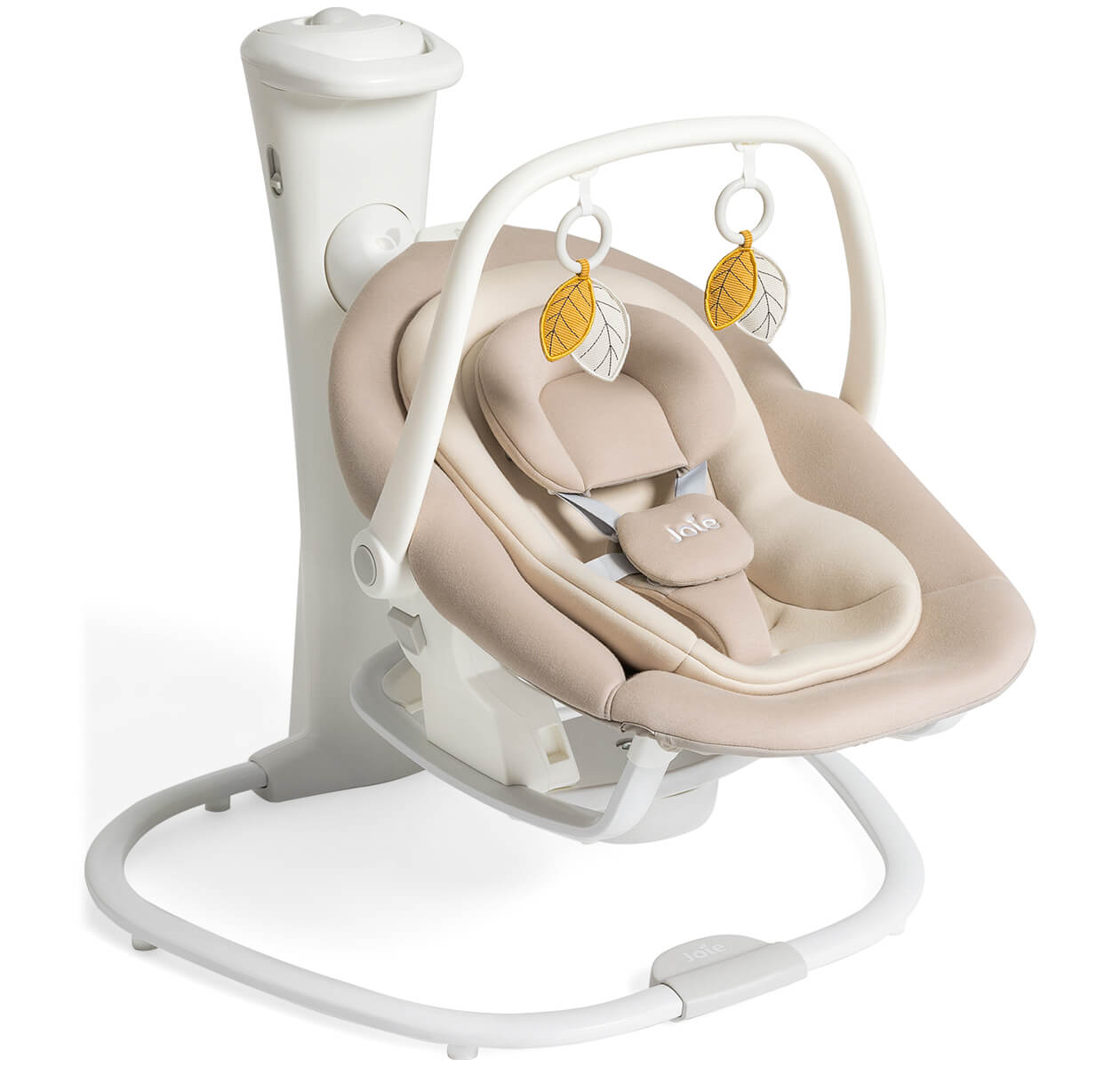
Your needs, this model
Does it fit your priorities?
Does the Ancho swing need D cells or an AC adapter?
No. The swing uses a hand-wound spring, not batteries, an adapter or an electric motor. When the seat is detached as a rocker, movement is caregiver- or infant-driven. The manual says not to open the spring housing because of stored spring tension.
Explore this need in the finder →What exactly does the wind-up swing's 25 lb limit mean?
The swing mode is listed from birth to 25 lb and 30 in, stopping when the child attempts to climb out, reaches the weight limit or reaches the height limit, whichever comes first. The detached rocker has a different 20 lb/27 in limit and an earlier stop when the child starts trying to sit up.
Explore this need in the finder →Are its soft goods machine-washable?
Joie identifies the insert and fabrics as machine-washable. Follow the care tag on each component, and do not assume a dryer setting or apply a fabric wash instruction to the wind-up housing or frame.
Explore this need in the finder →Wind-up is not the same as motor-powered
This is a document-based review of Joie's U.S. ancho™ wind-up 2-in-1 swing and rocker, model W2313AB. It is not a hands-on test. Its central difference is the power source: a caregiver winds a spring mechanism, selects a speed level and gives the seat a light push to start. The exact product page says no electricity or batteries are needed. This makes Ancho distinct from Joie's mains/battery-powered Cinnamon and Miso swings, and it should not be matched as a motor-powered swing just because its seat moves automatically after winding.
Joie's U.S. manual says about 35 turns fully wind a completely unwound mechanism. It describes a three-level switch—high, medium and low—and says a full wind runs for roughly 30 minutes, with duration varying by the child's weight. These are manufacturer instructions and approximate guidance, not a measured or guaranteed runtime. Winding is part of the routine, and an adult has to start the motion; if hands-free, continuous electrical movement is a priority, a spring-wound model may not suit that task. The manual also warns that spring parts can be under tension and says not to open or disassemble the housing.
Two directions and a separate rocker
The swing's seat turns to choose a front-to-back or side-to-side direction. The direction is selected, not simultaneous. In another setup, the seat lifts off as a portable manual rocker; that mode is moved by caregiver or infant rather than the swing's spring. The overhead toys, carry handle and rock-stop foot support these two uses, but the handle is not permission to lift or carry a baby in the assembled swing. Keep the rocker on the floor and use its stop foot when the manual's stationary setup is appropriate.
The assembled swing measures 36.5 inches long by 30 inches wide and 28.75 inches high, and weighs about 25.5 pounds. The detached rocker is listed at 26 × 20.25 × 21.5 inches and about 7.9 pounds. The separate rocker is narrower, but its smaller size should not be used to judge the swing-on-frame footprint. The overall body is not especially narrow, and no folded dimension is published in the pages reviewed. Leave floor clearance for movement rather than planning around the static body measurement alone.
Read the two mode limits separately
Joie lists the swing from birth to 25 pounds and 30 inches. The manual says to stop at the first of the child attempting to climb out, reaching 25 pounds or reaching 30 inches; about nine months is only an approximate age reference. The rocker has a lower, different limit: birth to 20 pounds and 27 inches, and it must stop when the baby begins trying to sit up. That earlier developmental stop is important even if a child is below the listed weight.
The manual also requires the swing to remain fully reclined until the child is at least four months old and can hold their head up without help. Use the five-point restraint, keep the product on the floor, stay nearby and move a sleeping baby to a firm, flat sleep surface. Joie warns that it is not safe for sleep or unsupervised use; it is not a substitute for a crib or bassinet. Do not carry the rocker in a vehicle, place it on a table or use a damaged product or unapproved replacement parts.
Textile care and practical limitations
Unlike models whose pages only identify a washable infant support, Joie's exact Ancho page and U.S. support article explicitly say that its insert and fabrics are machine-washable. The manual still points caregivers to the care tags for each piece, so check those labels before laundering and do not assume a particular dryer setting. The spring housing and frame are not fabric; the manual's warning against opening the spring mechanism is especially relevant when cleaning or repairing around that assembly.
Ancho does not offer documented battery, outlet, remote, phone-app or voice-assistant operation. Its swing requires repeated winding and a gentle push; the approximate runtime varies with child weight. Its 30-inch width and 36.5-inch depth call for a planned floor zone. Those are real tradeoffs, not defects: the spring mechanism avoids cords and battery changes, while still delivering a manually prepared swing motion. If the desired task is a caregiver- or infant-driven seat without a motor, the detached rocker mode is the relevant arrangement. If the task is a spring-wound swing, the questionnaire has no dedicated wind-up option, so a result under “manual seat” should not be taken as proof that the swing itself is manually rocked.
What to verify before selecting an offer
Check that the unit label says W2313AB and that the seller is offering the wind-up swing/rocker rather than a related Joie seat. Confirm the assembly hardware, rocker, spring handle, speed switch and correct U.S. manual. Inspect the spring housing and stop using the unit if parts are damaged; do not try to open it. Check current recall notices for a used product and compare the manufacture date. Measure the assembled frame's full width and depth, confirm the washable label for each textile part, and plan for the two distinct limits. This assessment does not claim live stock, a price, consumer experience, a serial-number recall clearance or hands-on performance.
Sources: Joie's exact U.S. Ancho product page, Joie U.S. Ancho support/model record, and the U.S. instruction manual.
Key specifications
Key details at a glance
| Motion type | Wind up swing |
|---|---|
| Powered speed settings | 3 |
| Power modes | spring_wind_up / manual_rocker |
| Product weight | 25.5 lb |
| Body width | 30 in |
| Front-to-back body dimension | 36.5 in |
| Manufacturer-listed weight limit | 25 lb |
| Approximate age reference | 9 months |
| Harness points | 5 |
| Phone app control | No |
| Machine-washable seat textiles | Yes |
Use the exact model’s instructions for operating limits, supplied equipment and version differences.
Sources for this review
Sources for this assessment

Compare this model with your actual requirements
Use the finder to combine movement, power, control, care, newborn support and published body dimensions. It does not calculate motion clearance or override model-specific warnings.