
Your needs, this model
Does it fit your priorities?
Can the Mamaroo be used from birth?
The manufacturer lists this US model for use from birth and includes a newborn support insert. The manual says to keep the seat fully reclined until the infant is at least four months old and can hold their head up without help; follow every harness and supervision instruction, and stop by 25 lb or when the child attempts to climb out, whichever comes first.
Explore this need in the finder →Does the Mamaroo need batteries or a nearby outlet?
The reviewed model runs from its included AC adapter; the manufacturer says no batteries are needed. It is therefore a plug-in arrangement, not a documented battery-only choice. Keep the supplied cord out of the baby's reach as the manual directs.
Explore this need in the finder →Can I remove and wash the Mamaroo seat fabrics?
Yes. The manual says the seatback fabric and infant insert are removable and machine-washable in cold water with mild detergent, then dried flat. Toy fabric is spot-clean only; do not assume every textile has the same care method.
Explore this need in the finder →Can I adjust the Mamaroo from a phone?
The product page and manual describe UPPAbaby Connect app control for motion, speed and sound, with Bluetooth connectivity. Voice integration is separately listed for Amazon Alexa and Google Home. Confirm app and device support for your own phone before relying on connected control.
Explore this need in the finder →Which Mamaroo this review covers
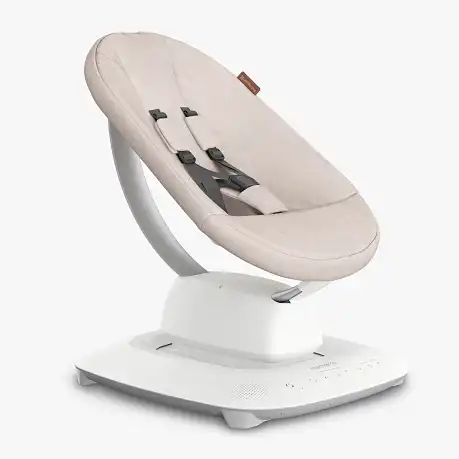
This assessment is for UPPAbaby’s current US Mamaroo Smart Swing, model 2001-MRO-NA. The reviewed finish is Charlie / Sand Mélange, SKU 2001-MRO-NA-CHR. UPPAbaby’s US product page also lists Jake, Stella, Wells and Camila finishes under the same model family. Their suffixes change the fabric color, not the documented motion, power, controls or care, so they share this functional assessment. The older 4moms model number 1046 is not assumed to be this version: check the label under a used unit rather than relying on the Mamaroo name.
This is a document-based review of manufacturer instructions and specifications, not a hands-on test. The swing’s appeal is its combination of powered movement and app-connected adjustment; the practical cost of that setup is a cord, a floor-only location and a set of use limits that should stay visible after assembly.
Five motion patterns, but not a portable bouncer
The Mamaroo uses a motorized seat with five named patterns—cruise, bounce, sway, rock and wave—and five speed settings. Its movement combines up-and-down and side-to-side travel, rather than relying on the baby to make the seat move. Four built-in sounds add a separate soothing option. UPPAbaby describes more than 400 combinations across motions, speeds and sounds; that is a manufacturer count of settings, not evidence that every baby will settle in one.
Controls are more flexible than a basic on-frame switch: the touch-sensitive panel can be used directly, and UPPAbaby Connect offers phone adjustment over Bluetooth. UPPAbaby also lists Alexa and Google Home smart-home integration. If those connected controls are important, confirm your phone and app support before buying; no compatibility claim here replaces checking the current app listing. The on-unit controls remain the simpler fallback when a phone is elsewhere.
By contrast, a manually moved bouncer depends on a caregiver’s or infant’s movement. That may be a better match if you want a non-motorized seat or do not want a power cord in the room. The Mamaroo’s feature set is most relevant when automatic, variable motion is itself a requirement.
Measure the body and the moving zone
UPPAbaby lists the Mamaroo at 21 inches wide and 24 inches deep; the frame height changes with recline, from 22 3/8 inches at its most reclined to 27 1/8 inches at its most upright. The unit weighs 15 pounds. Those are useful starting points for a room sketch, not a complete operating-space measurement: the manufacturer does not give a swept-clearance envelope for the seat’s motion. Leave a clear zone around it and keep it on the floor, not on a bed, sofa, counter or other raised surface.
The product page calls the design compact, but it does not document a folding or carry mode. Nor does the reviewed manual support battery operation: the included AC adapter powers this configuration. Plan for an outlet without routing the cord where a baby can reach it. A family moving the seat frequently between rooms should verify how the assembled base fits those doorways and where it can be plugged in before treating it as portable.
Newborn use has specific limits
The manufacturer lists use from birth and includes a soft newborn support insert. The manual says that insert is for use to about four months, and the swing must remain fully reclined until the baby is at least four months old and can hold their head up without help. These are operating conditions, not optional comfort tips; ask a clinician about timing if your baby has special needs or cannot use the seat in the positions the manual describes.
Stop using the swing when the child reaches 25 pounds or attempts to climb out, whichever comes first; the manufacturer gives about nine months as an approximate age reference. A child’s ability to climb out may bring the stop point earlier. The manual also requires the restraint to be used and adjusted snugly, an adult to stay nearby and supervise, and indoor floor placement. The Mamaroo is not intended, designed or marketed for sleep or unsupervised use. If a baby falls asleep, move them as soon as possible to a firm, flat sleep surface such as a crib or bassinet.
Textile care is manageable, with separate rules for each part
The seatback fabric and newborn insert can be removed and machine-washed in cold water with mild detergent; dry them flat before use or storage. The toy fabric is spot-cleaned, not treated as machine-washable seat fabric. The manual calls for a damp cloth and mild detergent on the frame, followed by thorough drying. Do not fold or store the unit damp, and use only replacement parts and accessories approved by UPPAbaby. A quick check of the manual’s care diagram before the first wash can prevent treating every soft part the same way.
What to confirm on the exact offer
Match the label to 2001-MRO-NA and the finish suffix, confirm the supplied AC adapter, toy mobile and newborn insert are present, and read the current manual before assembly. If considering a second-hand Mamaroo, inspect its full model number: the CPSC’s 2022 recall names older three-point-harness models 4M-005, 1026 and 1037, while stating that five-point-harness MamaRoo models are not included. This review concerns the separately numbered 2001-MRO-NA; a similar name alone is not enough to identify a used swing or its recall status.
In short, the Mamaroo is a plausible option for a household that values powered multi-axis motion, app controls and washable seat textiles and has a suitable outlet-side floor space. It is a poor fit for a battery-only routine, an unattended nap solution, or a location where its moving zone and cord cannot be kept clear. Check the exact model, included pieces, space and current instructions together—not just the fabric or feature list. See the manufacturer’s Mamaroo product information, the model 2001-MRO-NA manual and the CPSC recall notice for the exact distinctions.
Key specifications
Key details at a glance
| Motion type | Powered movement in multiple directions |
|---|---|
| Named motion patterns | 5 |
| Powered speed settings | 5 |
| Built-in sound choices | 4 |
| Power modes | ac_mains |
| Product weight | 15 lb |
| Body width | 21 in |
| Front-to-back body dimension | 24 in |
| Height, most upright | 27.12 in |
| Height, most reclined | 22.38 in |
| Manufacturer-listed weight limit | 25 lb |
| Approximate age reference | 9 months |
| Harness points | 5 |
| Phone app control | Yes |
| Machine-washable seat textiles | Yes |
| Newborn insert included | Yes |
| Recall status for reviewed model | No |
Use the exact model’s instructions for operating limits, supplied equipment and version differences.
Sources for this review
Sources for this assessment
Compare this model with your actual requirements
Use the finder to combine movement, power, control, care, newborn support and published body dimensions. It does not calculate motion clearance or override model-specific warnings.